Puppy crate training schedule
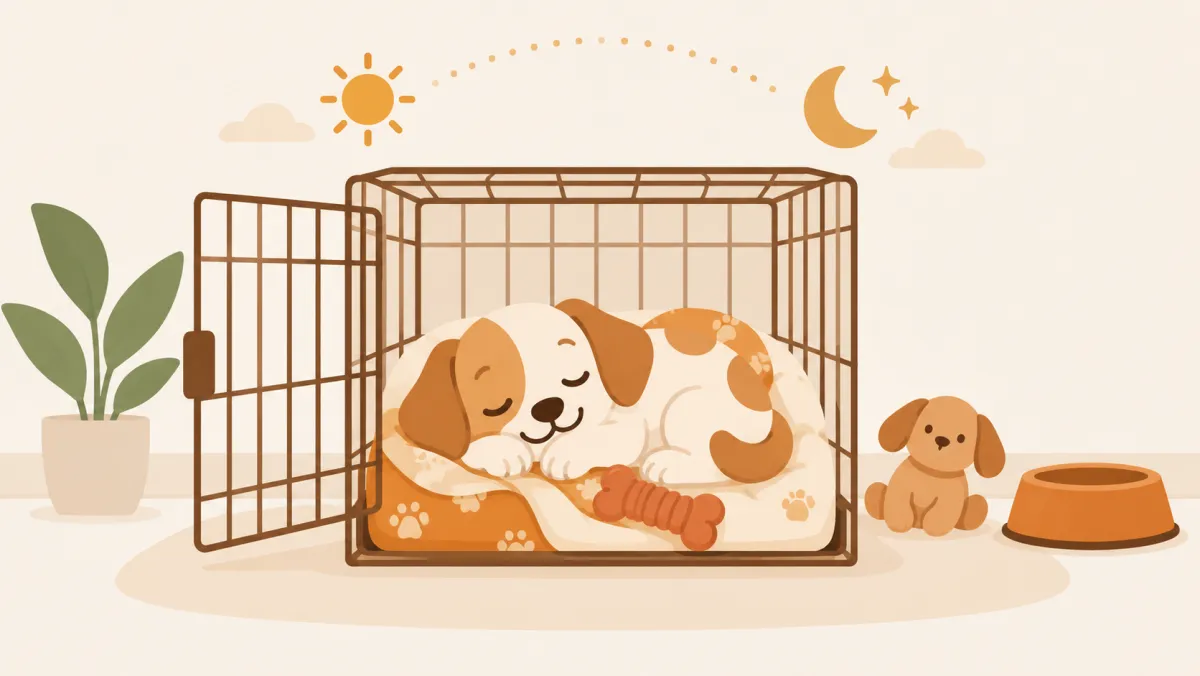
A crate schedule is a loop. Take the puppy out of the crate and straight outside. Then give them a short awake window, then a crate nap, and repeat. At 8 to 10 weeks a single stretch in the crate in the daytime should be no more than 30 to 60 minutes.
Enter your own day and your puppy's age. The crate naps, the trips outside and the night alarm fill in below.
If you choose a nap longer than is safe for your puppy's age, the schedule shortens it.
How long in the crate, by age
| Age | Daytime crate stretch, at most | Awake window between naps | Overnight in the crate |
|---|---|---|---|
| 8 weeks | 30 minutes – 1 hour | 55 minutes | about 3 hours |
| 10 weeks | 30 minutes – 1 hour | 1 hour 10 min | about 4 hours |
| 12 weeks | 1 hour – 3 hours | 1 hour 25 min | about 4 hours |
| 14 weeks | 1 hour – 3 hours | 1 hour 35 min | about 5 hours |
| 16 weeks | 3 hours – 4 hours | 1 hour 50 min | about 5 hours |
| 20 weeks | 4 hours – 6 hours | 2 hours 20 min | about 6 hours |
| 24 weeks | 4 hours – 6 hours | 2 hours 45 min | about 6 hours |
The daytime ranges are a ceiling, not a target. A puppy who spends the whole day at the top of the range is spending too much of it in a box. The overnight figure is longer because a sleeping puppy is not eating, drinking or playing, which are the three things that fill a bladder quickly.
The first week, step by step
- Days 1–2: door open. Toss treats in, feed meals just inside, and let the puppy walk in and out on their own.
- Days 3–4: close the door for a few minutes while the puppy works on a chew, with you sitting next to the crate. Open it before they ask.
- Days 5–7: first real crate naps, following the schedule above. Out and straight outside the moment they wake up.
- Nights from day one: the crate is next to your bed, with one planned trip outside if the puppy is too young to hold it until morning.
Getting the crate right
Choose a crate big enough for the puppy to stand, turn around and lie flat, and no bigger. A divider lets an adult-sized crate grow with the puppy. A crate with room for a bathroom corner gets a bathroom corner. Keep it where the household is, not in a back room. A puppy who can hear you settles much faster.
Never use the crate as a punishment, and do not leave a collar or tag on in the crate.
Where these numbers come from
The daytime crate ranges are the widely used guidance from the Humane Society of the United States. The awake windows and overnight hold are the same figures the sleep calculator and the schedule maker use, so all three pages agree.
Questions people ask
How long can a puppy stay in a crate during the day?
As a general guide from the Humane Society: 30 to 60 minutes at 8 to 10 weeks, 1 to 3 hours at 11 to 14 weeks, 3 to 4 hours at 15 to 16 weeks, and 4 to 6 hours from about 17 weeks. These are the most a puppy should spend in one stretch, not targets.
What does a crate training schedule look like?
A daytime crate schedule is a loop. Take the puppy out of the crate and straight outside. Give them an awake window of about an hour at 8 weeks, then crate them for a nap, then go straight outside again when they wake. At night the puppy goes into the crate after the last trip out, with one alarm if they are too young to hold it until morning.
How many times a night will a crated puppy need to go out?
Usually once until about 12 to 16 weeks. A puppy asleep in a crate holds about 3 hours at 8 weeks, 4 hours at 12 weeks and 5 to 6 hours by 16 weeks. That is why the schedule adds a night alarm only for puppies too young to make it to morning.
Should I crate my puppy for every nap?
Not every nap has to be in the crate, but crate naps in the daytime are what make the crate feel ordinary. A puppy who only goes into the crate at night or when you leave learns that the crate means being left. Short, regular daytime naps in the crate prevent that.
What if my puppy cries in the crate?
In the first few days, some crying at first is normal and usually fades within minutes. Check the basics first: have they just been out, are they tired, is the crate where they can hear you? Then wait for a quiet moment before opening the door. Crying that goes on, or real panic, is a sign to slow down and ask a qualified, reward-based trainer.
How long does crate training take?
Many puppies nap calmly in the crate within one to two weeks of short, regular sessions, and some take a month. Building time in the crate slowly matters more than any calendar.
Puppy Routine is not veterinary advice, and neither is this page. Anything about your puppy's health or a behaviour that worries you is a conversation with a veterinarian or a qualified, reward-based behaviour professional.